

Mastering FLSA Overtime: A Comprehensive Compliance Checklist for Employers

You're running a business, and you've got a million things on your plate. But among all the priorities, there's one area that demands your meticulous attention: FLSA overtime. It's not just another regulatory hurdle; it's a foundational element of fair labor practices that, if mishandled, can lead to significant financial and reputational damage. This isn't just about avoiding penalties; it's about building a robust, ethical operation that protects both your business and your employees.
The FLSA Overtime Conundrum: Why Every Employer Needs to Master It
Imagine you're building a house. You wouldn't skip the foundation, right? FLSA overtime compliance is the foundation of your payroll and labor practices. Many employers view it as a complex, headache-inducing requirement, but that perspective misses the bigger picture. Mastering FLSA overtime isn't about memorizing obscure pay rules; it's about understanding the spirit of fair compensation and implementing systems that reflect that commitment. It's about ensuring your hard-working team is compensated accurately for every hour they dedicate to your business. Ignoring it, or even misunderstanding a crucial detail, is like building that house on quicksand—it might stand for a while, but eventually, it will crumble.
Understanding the Foundation: What Exactly is FLSA Overtime?
At its heart, the Fair Labor Standards Act (FLSA) is a federal law establishing federal minimum wage, overtime pay, recordkeeping, and youth employment standards affecting minors and covered employers. The FLSA also includes child labor provisions that restrict the types of work and number of hours minors can perform, as well as child labor protections for minor employees in hazardous occupations. When we talk about FLSA overtime, we're specifically focusing on the requirement that most non-exempt employees must be paid one and one-half times their regular rate of pay for all hours worked over 40 in a workweek. Simple in concept, perhaps, but devilishly complex in application.
The U.S. Department of Labor's Wage and Hour Division (WHD) is the federal agency responsible for enforcing the FLSA's overtime rules and other employment laws. The WHD publishes detailed fact sheets and guidance to help employers understand their overtime obligations—resources well worth bookmarking.
Who's Covered? Decoding Employee Classifications
The very first step in understanding FLSA overtime is knowing who it applies to. This hinges on employee classification. The FLSA divides employees into two main categories: exempt and non-exempt.
Non-exempt employees are those who are entitled to minimum wage and overtime pay protections. Think of your hourly production line workers, administrative assistants, or retail staff. The vast majority of employees fall into this category and are considered eligible employees for overtime.
Exempt employees, on the other hand, are exempt from FLSA's minimum wage and overtime requirements. This isn't a classification you can arbitrarily assign. To qualify for an overtime exemption, an employee must meet three stringent tests—often referred to as the white-collar exemptions:
Salary Basis Test: They must be paid a predetermined, fixed salary that does not vary with the quality or quantity of work performed.
Salary Level Test: Their salary must meet a specific minimum salary threshold set by the Department of Labor (DOL). The DOL's final rule periodically updates this salary level, and highly compensated employees have a separate, higher threshold. Staying current with these updates is crucial.
Duties Test: Their primary job duties must fall within one of the recognized executive, administrative, professional exemption, outside sales, or computer employee exemptions. This is where it gets particularly nuanced, as the DOL provides detailed definitions for each. For instance, an "administrative" exempt employee isn't just someone who performs administrative tasks; their exempt duties must involve the exercise of discretion and independent judgment with respect to matters of significance. Similarly, professional employees must perform work requiring advanced knowledge in a field of science or learning.
Misclassifying an employee's exempt status when they should be non-exempt is one of the most common and costly FLSA violations. It's a critical distinction to get right from day one.
The Core of Compliance: The Overtime Pay Calculation
Once you've correctly identified your non-exempt employees, the next step is calculating their overtime pay. This isn't always as simple as multiplying their hourly rate by 1.5.
The "Regular Rate of Pay"—It's More Than Just Hourly Wages
This is where many employers stumble. The employee's regular rate is not just their standard hourly wage or regular pay. It's a dynamic figure that includes most forms of an employee's compensation paid to them, even if those payments are not based on an hourly rate. The FLSA requires that total compensation for the workweek be factored in. This can include:
Hourly wages: Your standard pay.
Non-discretionary bonuses: Bonuses promised to employees, like those tied to production goals or attendance. If an employee works toward a bonus for achieving certain metrics, it's generally non-discretionary.
Commissions: Payments based on sales or performance.
Shift differentials: Extra premium pay for working undesirable shifts (e.g., night shift pay).
Piece-rate payments: Pay based on the number of units produced.
On-call pay: Payments for being available to work, even if not actively working, unless certain conditions are met.
What generally doesn't get included are true discretionary bonuses (where both the decision to pay and the amount are at the employer's sole discretion), gifts, expense reimbursements, and certain benefit plan contributions.
The FLSA requires that all such includable compensation be factored in. To calculate the regular rate, you generally add up all includable compensation for the workweek and divide it by the total hours actually worked during that workweek.
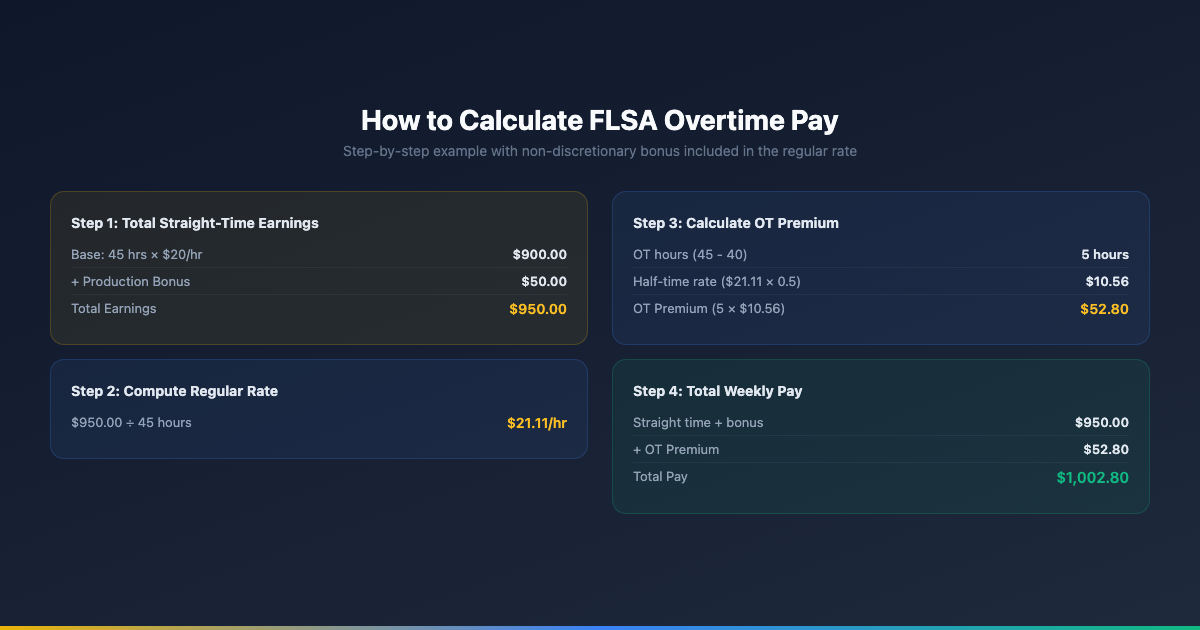
Let's illustrate: Suppose an employee earns $20/hour and works 45 hours in a week. They also received a $50 non-discretionary production bonus for that week.
Total Straight-Time Earnings: (45 hours × $20/hour) + $50 bonus = $900 + $50 = $950
Regular Rate of Pay: $950 / 45 hours = $21.11 per hour (This is their true regular rate for the week).
The 1.5x Rule: When and How It Applies
Once you have the regular rate, the 1.5x rule comes into play. For every hour worked over 40 in a workweek, the employee must receive one and one-half times their regular rate.
Continuing our example:
Overtime Hours: 45 hours − 40 hours = 5 hours
Overtime Premium: ($21.11 regular rate × 0.5) × 5 overtime hours = $10.56 × 5 = $52.80
Notice we multiply by 0.5 here, not 1.5. That's because the straight time portion for all 45 hours (which was already included in the initial $900 wage calculation) has already been accounted for. The overtime premium is the additional half-time pay.
Total Pay for the Week: $950 (straight time and bonus) + $52.80 (overtime premium) = $1,002.80
Getting this calculation right, especially with fluctuating workweeks, bonuses, and other forms of compensation, requires diligence and precision.
Your Comprehensive FLSA Overtime Compliance Checklist
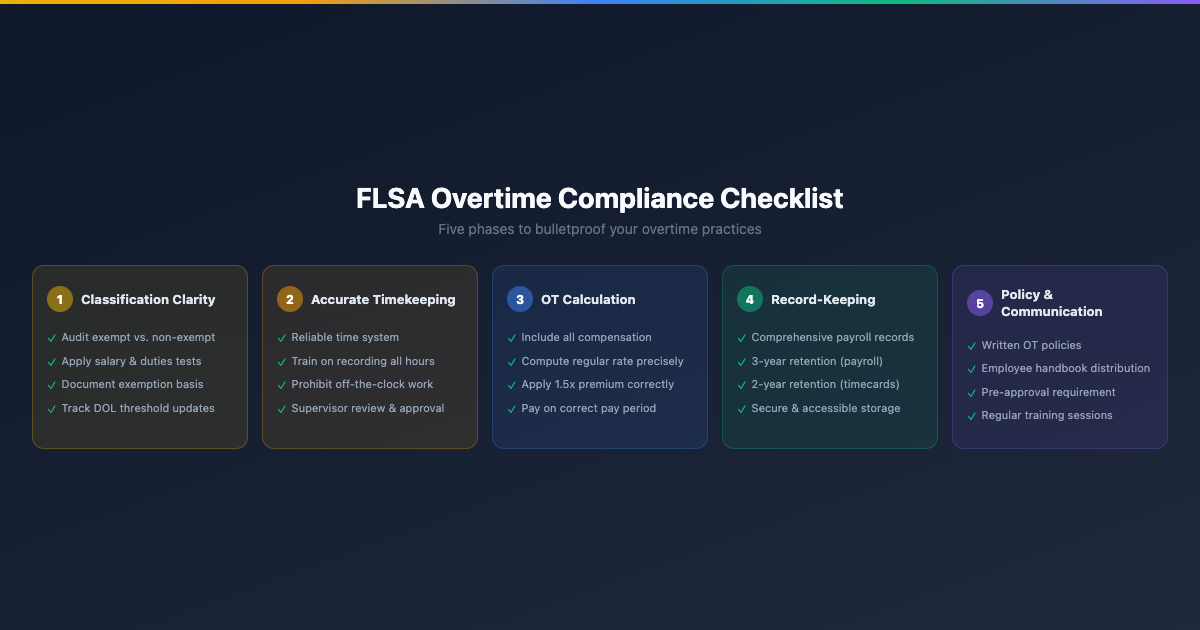
Here's a practical, actionable checklist to ensure your FLSA overtime practices are bulletproof.
Phase 1: Classification Clarity—Are Your Employees Correctly Labeled?
This is your first line of defense.
Audit current classifications: Don't assume your current labels are correct. Review every exempt position against the DOL's salary level and duties tests. Pay special attention to job duties actually performed, not just titles.
Document your reasoning: For each exempt employee, keep a record explaining why they meet the specific exemption criteria. This documentation is invaluable if challenged.
Stay updated: The DOL updates salary thresholds periodically. Ensure your exempt employees always meet the current minimum salary level. Also watch for state law changes—states like California often have stricter overtime laws and higher salary thresholds than federal standards.
Phase 2: Accurate Timekeeping—The Unsung Hero of Compliance
You can't calculate overtime correctly if you don't know exactly the number of hours worked.
Mandate accurate record-keeping: Implement a reliable timekeeping system (time clocks, software, etc.) that accurately captures all work time, including start/end times, meal breaks, and any "off-the-clock" work. For a broader look at how time tracking supports legal obligations, see our guide to time tracking and compliance.
Train employees on timekeeping policies: Ensure employees understand the importance of recording all time, including short breaks, pre-shift, and post-shift activities.
Prohibit "off-the-clock" work: Make it clear that employees cannot work before, during, or after their shifts without clocking in. If such work occurs, it must be paid.
Review and approve timesheets: Supervisors should regularly review and approve timesheets to catch errors or discrepancies.
Define the workweek clearly: A workweek under the FLSA is a fixed, regularly recurring period of 168 hours—seven consecutive 24-hour periods. It can begin on any day and at any time, but it must be consistent. Once set, it should not change to manipulate overtime calculations.
Phase 3: Calculating and Paying Overtime—Getting It Right Every Time
This is where the rubber meets the road.
Identify all forms of compensation: Understand what compensation must be included in the regular rate for non-exempt employees (e.g., non-discretionary bonuses, commissions, shift differentials).
Calculate the regular rate precisely: Ensure your payroll system or process accurately computes the employee's regular rate by dividing total includable compensation by total hours worked for the week.
Apply the 1.5x premium: Correctly calculate the additional half-time pay for all hours over 40, based on the regular rate.
Pay on time: Overtime wages must be paid on the regular payday for the pay period in which the hours were worked. Don't defer overtime to a later pay period.
Phase 4: Record-Keeping Essentials—Your Legal Shield
Good records are your best defense.
Maintain comprehensive payroll records: This includes employee name, address, occupation, workweek, regular rate of pay, total daily/weekly hours worked, total straight-time earnings, total overtime earnings, deductions, and total wages paid.
Retain records for required periods: The FLSA generally requires employers to keep payroll records for three years and records used to calculate pay (like timecards) for two years.
Store records securely and accessibly: Ensure records can be retrieved easily if audited.
Phase 5: Policy and Communication—Setting Clear Expectations
Transparency and clear rules reduce confusion and potential disputes.
Develop clear written policies: Include policies on work hours, timekeeping, meal and rest breaks, and overtime authorization.
Communicate policies effectively: Ensure all employees receive and understand these policies, perhaps through an employee handbook and regular training.
Require overtime authorization: Establish a policy that overtime must be pre-approved by a supervisor. While unauthorized overtime still must be paid, this helps manage labor costs.
Common Pitfalls and How to Avoid Them
Even with the best intentions, employers can inadvertently fall into common FLSA traps.
Misclassifying Employees: The Costly Mistake
This is perhaps the biggest pitfall. Believing an employee is exempt because they are salaried, or because they have a "manager" title, without actually meeting the duties test, is a recipe for disaster. The DOL looks at actual job duties performed, not just job titles or payment methods. Avoid this by meticulously auditing classifications and documenting the basis for exemption.
Failing to Include All Compensation in the Regular Rate
Overlooking non-discretionary bonuses, commissions, or other forms of compensation when calculating the regular rate is a frequent error. This artificially lowers the regular rate, leading to underpayment of overtime. Prevent this by understanding all forms of compensation and their inclusion requirements in the regular rate calculation.
Ignoring "De Minimis" Time: Every Minute Counts
"De minimis" refers to small, insignificant periods of time that are impracticable to record. However, what an employer considers "de minimis" might not be so in the eyes of the DOL. Five minutes of unpaid work before a shift, consistently done by multiple employees, can add up quickly. The safest approach is to pay for all time worked, or ensure employees are truly relieved of all duties and not performing any work, no matter how brief, during unpaid periods.
Overlooking State Overtime Laws
Federal overtime rules set the floor, but many state laws impose additional overtime requirements. Some states mandate daily overtime (paying overtime for hours over 8 in a single day), while others have industry-specific rules—healthcare employers, for instance, may face unique overtime regulations in certain states. Always apply the standard more favorable to the employee.
The Consequences of Non-Compliance: Why It Matters
The stakes are high. Non-compliance with FLSA overtime rules isn't just a slap on the wrist; it can profoundly impact your business.
Back Pay and Liquidated Damages
The most immediate financial consequence is the requirement to pay back wages for all underpaid overtime. In many cases, employers are also liable for an equal amount in "liquidated damages," effectively doubling the back wages owed. This can be substantial, especially if the violations span multiple years and employees.
Penalties and Fines
Beyond back pay and liquidated damages, the DOL can assess civil money penalties for willful violations. State labor departments often have their own penalties, which can be even more stringent.
Reputational Damage and Employee Morale
The financial costs are often just the beginning. Investigations and lawsuits can severely damage your company's reputation, making it harder to attract top talent and retain current employees. Low employee morale and distrust can lead to decreased productivity and increased turnover. In today's interconnected world, negative publicity travels fast.
Seeking Expert Guidance: When to Call in the Pros
While this guide provides a strong foundation, FLSA compliance can be incredibly complex.
When you have complex pay structures: If your employees receive commissions, piece rates, multiple bonuses, or work fluctuating schedules.
When you're unsure about classifications: If you're questioning whether a position truly meets an exemption test.
During growth or changes: Expanding into new states or significantly changing job roles can introduce new compliance challenges.
Proactive audits: Consider hiring an expert for a proactive FLSA audit to identify and correct issues before they become costly.
An experienced labor law attorney or HR consultant specializing in wage and hour laws can provide invaluable guidance, perform audits, and help you establish compliant practices, saving you significant headaches and costs down the line.
Your Path to FLSA Overtime Mastery
Mastering FLSA overtime isn't about fear; it's about empowerment. By understanding the overtime rules, implementing robust systems, and fostering a culture of compliance, you protect your business, ensure fair compensation for your employees, and build a stronger, more resilient organization. View this not as a burden, but as an essential investment in the integrity and future success of your enterprise.
