PTO Payout Laws by State (2026): Where Unused PTO Must Be Paid Out

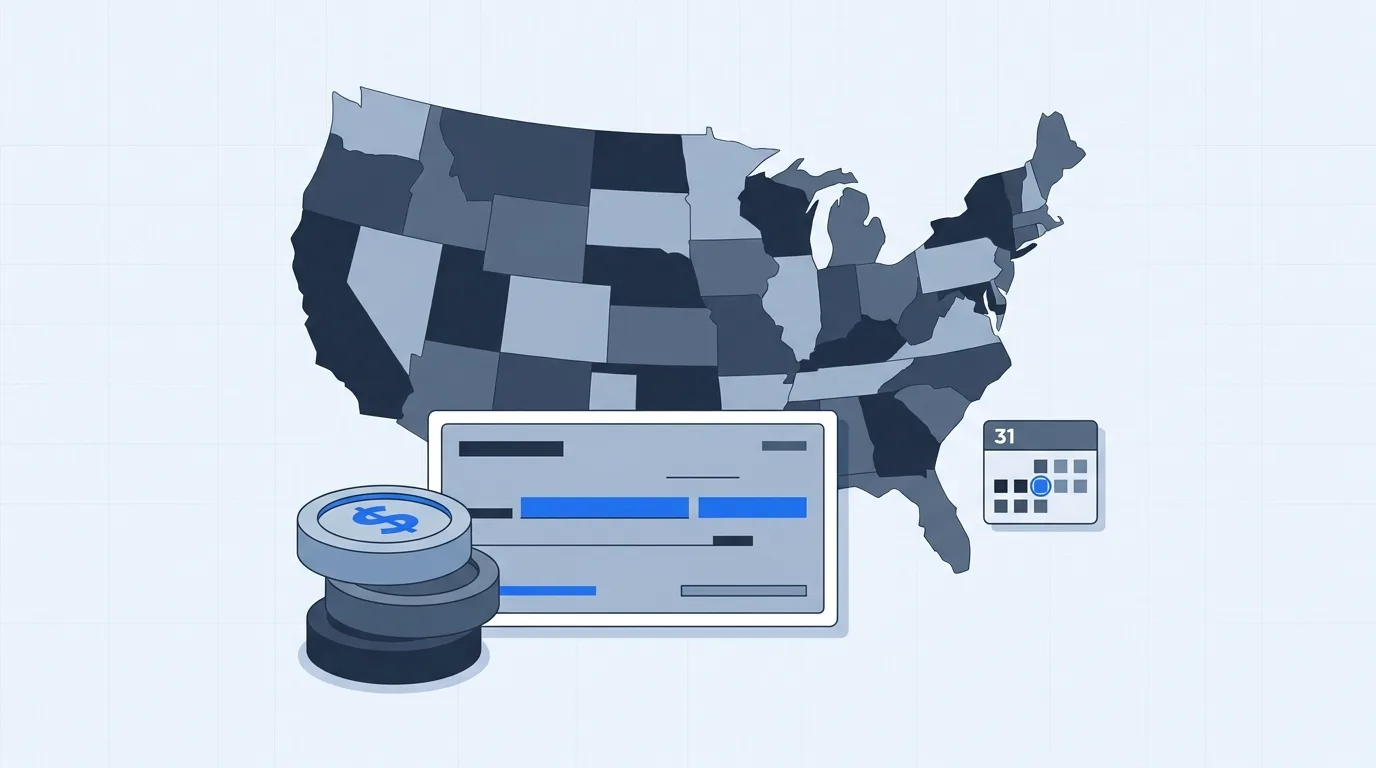
No federal law requires an employer to pay out unused PTO when an employee leaves. Whether you get paid for the vacation days still sitting in your balance depends on the state you work in and, in most states, on what your employer's written policy says. Four states treat accrued vacation as earned wages that can never be forfeited. Roughly a dozen more require a payout unless the employer's policy clearly says otherwise. The rest leave it entirely to the employer.
This guide covers the three legal approaches, a state-by-state table, how to calculate a payout, and how the payment is taxed. If you are new to the vocabulary, start with what PTO is and how it works.
Reviewed September 2026
This table was cross-checked against two current payroll-compliance sources in September 2026. State wage laws change through legislation, agency guidance, and court decisions, and some states have nuances that a one-line summary cannot capture. Confirm the current rule with your state labor department before paying a final check, and see our labor law compliance guides for state-level detail.
- No federal law requires PTO payout; the Fair Labor Standards Act does not cover vacation at all
- California, Colorado, Montana, and Nebraska treat accrued vacation as wages and prohibit use-it-or-lose-it policies
- About a dozen states require payout unless the employer has a written policy that says accrued time is forfeited
- Most state payout rules cover vacation and general PTO banks, not separate sick leave balances
- A PTO payout is a supplemental wage: the employer may withhold federal income tax at a flat 22 percent
What PTO payout means
A PTO payout is a cash payment for paid time off an employee earned but did not use, paid at the employee's current rate of pay. It most often happens at separation, whether the employee quits, is laid off, or is fired. Some employers also allow voluntary cash-outs during employment, and some pay out excess balances at year end instead of letting the time roll over.
Payout rules attach to leave that an employee has accrued, meaning earned through time worked or service. Time that has not accrued yet is never owed. A new hire who was promised 15 days a year but leaves after three months has accrued roughly a quarter of that, not the full 15.
Which leave types payout laws cover
Most state payout laws talk about "vacation" or "vacation pay." Courts and labor departments generally treat a combined PTO bank the same way, because the employee can use it for vacation. Sick leave is different. Nearly every state with a paid sick leave mandate, including the ones covered in our paid sick leave laws guide, explicitly says employers do not have to pay out unused sick time at separation.
| Leave type | Usually covered by payout laws? | Why |
|---|---|---|
| Vacation | Yes | The statutes and court decisions are written around vacation pay |
| Combined PTO bank | Yes, in most states | Treated like vacation because it can be used for vacation |
| Sick leave (separate bank) | No | State sick leave laws generally exclude payout |
| Floating holidays and personal days | Depends on the policy | Often treated as vacation if they accrue and can be used freely |
| Unlimited PTO | No | Nothing accrues, so there is no balance to pay |
This is one reason employers who combine vacation and sick time into one PTO bank take on more payout exposure than employers who keep them separate. It is also why unlimited PTO removes the payout question entirely.
The three approaches states take
Every state falls into one of three groups.
Payout is required by statute. Accrued vacation is treated as earned wages. The employer must pay it on separation regardless of what the handbook says, and in the strictest states the employer cannot take it away through a use-it-or-lose-it policy either. California is the best-known example: under Labor Code section 227.3, vacation vests as it is earned and must be paid at the final rate of pay.
Payout is required unless the employer's written policy says otherwise. The default is payout, but an employer can avoid it with a clear, written policy or contract stating that unused time is forfeited at separation. If the policy is silent, the employee gets paid. Illinois, Maryland, New York, and North Carolina work this way, with different wording and enforcement in each.
Payout is left to employer policy. The state has no statute on vacation payout. Whatever the employer promised in writing controls, and an employer that pays out in practice may have created an enforceable expectation. Texas, Florida, and most of the South and Mountain West fall here. "Not required" in the table below means the state does not mandate it, not that an employer may ignore its own policy.
PTO payout laws by state
Categories in the payout column: Required means state law mandates payout of accrued, unused vacation or PTO at separation. Required unless policy says otherwise means the default is payout but a written forfeiture policy is enforceable. Per employer policy means the state defers to the written policy without a statutory default. Not required means no state law mandates payout, so the employer's policy governs. Where our two sources disagreed, the Notes column says Verify.
| State | Payout at separation | Use-it-or-lose-it policies | Notes |
|---|---|---|---|
| Alabama | Not required | Permitted | Employer policy governs |
| Alaska | Not required | Permitted | Employer policy governs |
| Arizona | Not required | Permitted | See our Arizona labor law guide |
| Arkansas | Not required | Permitted | Employer policy governs |
| California | Required | Prohibited | Vacation vests as earned; paid at final rate; caps allowed, forfeiture is not. California guide |
| Colorado | Required | Prohibited | Colorado Supreme Court (2021) confirmed earned vacation cannot be forfeited. Colorado guide |
| Connecticut | Not required | Permitted | Employer policy governs |
| Delaware | Not required | Permitted | Delaware guide |
| District of Columbia | Required unless policy says otherwise | Permitted | Verify. Sources disagree; DC wage law treats promised vacation as wages absent a written forfeiture policy. DC guide |
| Florida | Not required | Permitted | Florida guide |
| Georgia | Not required | Permitted | Georgia guide |
| Hawaii | Not required | Permitted | Employer policy governs |
| Idaho | Not required | Permitted | Employer policy governs |
| Illinois | Required | Permitted with notice | Wage Payment and Collection Act requires payout of earned vacation; use-it-or-lose-it allowed only with reasonable notice and a chance to use the time. Illinois guide |
| Indiana | Required unless policy says otherwise | Permitted | Courts treat vacation as deferred compensation unless the policy states otherwise. Indiana guide |
| Iowa | Not required | Permitted | Iowa guide |
| Kansas | Not required | Permitted | Kansas guide |
| Kentucky | Not required | Permitted | Kentucky guide |
| Louisiana | Required | Permitted | Accrued vacation is treated as wages due on separation |
| Maine | Required | Permitted | Verify. A 2023 law requires employers with 11 or more employees to pay out accrued vacation; one source still lists Maine as not required |
| Maryland | Required unless policy says otherwise | Permitted | Payout required unless a written policy given at hire says otherwise |
| Massachusetts | Required | Permitted with notice | Accrued vacation is wages under the Wage Act. Massachusetts guide |
| Michigan | Not required | Permitted | Michigan guide |
| Minnesota | Required unless policy says otherwise | Permitted | Verify. Sources disagree; payout generally follows the written policy. Minnesota guide |
| Mississippi | Not required | Permitted | Employer policy governs |
| Missouri | Not required | Permitted | Employer policy governs |
| Montana | Required | Prohibited | Earned vacation is wages and cannot be forfeited |
| Nebraska | Required | Prohibited | Nebraska Wage Payment and Collection Act treats accrued vacation as wages |
| Nevada | Required unless policy says otherwise | Permitted | Verify. Sources disagree; a written policy controls |
| New Hampshire | Not required | Permitted | Employer policy governs |
| New Jersey | Not required | Permitted | New Jersey guide |
| New Mexico | Required unless policy says otherwise | Permitted | Verify. Sources disagree |
| New York | Required unless policy says otherwise | Permitted with notice | Payout required unless a written policy states forfeiture. New York guide |
| North Carolina | Required unless policy says otherwise | Permitted with notice | Forfeiture must be stated in writing and communicated to employees |
| North Dakota | Required unless policy says otherwise | Permitted | Payout can be withheld only from employees who resign voluntarily under specific conditions; involuntary separations are paid |
| Ohio | Required unless policy says otherwise | Permitted | Verify. Sources disagree; written policy controls. Ohio guide |
| Oklahoma | Not required | Permitted | Employer policy governs |
| Oregon | Per employer policy | Permitted | Oregon guide |
| Pennsylvania | Not required | Permitted | Pennsylvania guide |
| Rhode Island | Required | Permitted | Required for employees with at least one year of service |
| South Carolina | Not required | Permitted | Employer policy governs |
| South Dakota | Not required | Permitted | Employer policy governs |
| Tennessee | Not required | Permitted | Employer policy governs |
| Texas | Not required | Permitted | Texas guide |
| Utah | Required unless policy says otherwise | Permitted | Verify. Sources disagree. Utah guide |
| Vermont | Not required | Permitted | Employer policy governs |
| Virginia | Not required | Permitted | Virginia guide |
| Washington | Not required | Permitted | Washington guide |
| West Virginia | Required unless policy says otherwise | Permitted | Verify. Sources disagree on both columns |
| Wisconsin | Required unless policy says otherwise | Permitted | Written policy controls. Wisconsin guide |
| Wyoming | Required unless policy says otherwise | Permitted | Written policy controls |
Sources reviewed: Paycor, "PTO Payout Laws by State" (updated November 2025) and Patriot Software, "PTO Payout Laws by State" (updated August 2026). Where the two disagreed, we used the more protective reading and flagged the row.
States that ban use-it-or-lose-it policies
A use-it-or-lose-it policy wipes out accrued vacation at a set date, usually the end of the calendar year or the employee's anniversary. Four states prohibit it because they treat earned vacation as wages that have already been paid in kind:
- California allows employers to cap how much vacation accrues, so an employee stops earning once the balance hits the cap, but time already earned can never be taken away.
- Colorado reached the same result through a 2021 state supreme court decision under its Wage Claim Act.
- Montana and Nebraska treat accrued vacation as earned wages under their wage payment statutes.
A cap and a forfeiture policy are not the same thing. A cap says "you stop accruing at 200 hours." A forfeiture policy says "anything over 80 hours disappears on December 31." The first is legal everywhere, including the four states above. The second is not legal in those four states and requires advance written notice in Illinois, Massachusetts, New York, and North Carolina.
Caps protect employers everywhere
Even in states with no payout law, an accrual cap limits your maximum liability. A 1.5x annual cap is common: an employee who earns 120 hours a year cannot bank more than 180. Our PTO accrual calculator shows how quickly a balance reaches a cap under different accrual rates.
How to calculate a PTO payout
The formula is the same everywhere: unused accrued hours multiplied by the employee's final regular rate of pay.
PTO payout = accrued unused hours × hourly rate
Hourly employee example
An agent earns $19.50 an hour and has 46.5 hours of accrued PTO when she resigns.
46.5 hours × $19.50 = $906.75 gross payout
If her PTO balance is tracked in days, convert to hours first using her standard day. Six days at 8 hours is 48 hours.
Salaried employee example
A salaried team lead earns $62,400 a year on a 40-hour week and has 9 days of PTO left.
- Convert salary to an hourly rate: $62,400 ÷ 2,080 hours = $30.00 per hour. Our salary to hourly calculator does this for any schedule.
- Convert days to hours: 9 days × 8 hours = 72 hours.
- Multiply: 72 hours × $30.00 = $2,160.00 gross payout.
Partial accrual in the final period
Most policies accrue PTO each pay period. If an employee leaves mid-period, prorate the final accrual. An employee who earns 4 hours per biweekly period and leaves 6 working days into a 10-day period has accrued 60 percent of that period's 4 hours, or 2.4 hours, on top of the existing balance. California and the other statutory states expect this proration; in policy states, follow the written policy.
Negative balances
If an employee used PTO before earning it and the balance is negative at separation, whether the employer can deduct the overage from the final check depends on state wage deduction law and whether the employee agreed in writing. Several states restrict deductions from final pay even with a signed agreement, so check before you deduct.
How PTO payout is taxed
A lump-sum payment for accrued vacation is a supplemental wage under federal rules. IRS Publication 15 (2026), section 7, lists vacation pay among supplemental wages and gives employers two options for federal income tax withholding when the payout is identified separately from regular wages:
- Flat rate: withhold 22 percent of the payout.
- Aggregate method: add the payout to the regular wages for the pay period and withhold on the combined amount using the normal tables.
If an employee's supplemental wages exceed $1 million in the calendar year, the portion over $1 million must be withheld at 37 percent. Social Security and Medicare taxes apply to the payout in full, and state income tax withholding follows each state's supplemental wage rules.
The payout is reported on the employee's Form W-2 with regular wages. Employees sometimes assume the flat 22 percent means the payout is taxed at a special rate. It is not. It is ordinary income; only the withholding method differs, and any over- or under-withholding settles on the annual return.
Final paycheck timing
Payout laws say whether accrued PTO is owed. Final paycheck laws say when it must be paid. The two are separate, and the deadline often depends on whether the employee quit or was terminated. California, for example, requires all wages including accrued vacation to be paid immediately on termination and within 72 hours of a resignation without notice. Other states allow payment on the next regular payday, and some set no deadline at all.
Our guide to time off rules for hourly employees in US states covers final pay timing alongside leave rules. Treat the PTO payout as part of the final wages and apply the state's final paycheck deadline to it.
Tips for multi-state employers and BPOs
Companies with agents in several states, including outsourcing providers and contact centers that hire remotely across the US, run into payout law more than most. A few practices keep it manageable.
- Apply the rule of the state where the employee works. Payout obligations follow the employee's work location, not the company's headquarters. A Texas company with a remote agent in California owes a California payout.
- Write the policy for the strictest state you operate in, or write state addenda. A single national policy that says "accrued PTO is forfeited at separation" is unenforceable in California, Colorado, Montana, and Nebraska and must be paired with written notice elsewhere. Our company leave policy template has a section for state variations.
- Keep vacation and sick leave in separate banks where sick leave is mandated. It limits payout exposure and keeps sick leave compliant with state accrual rules.
- Cap accruals. A cap is legal everywhere and bounds the liability on your balance sheet.
- Track balances to the hour. Payout disputes are usually balance disputes. A leave management system that records accruals, approvals, and usage per employee makes the final calculation a report, not an argument.
- Book the liability. Accrued PTO in payout-required states is a wage liability. Finance should see the balance total each month.
Track PTO Balances Down to the Hour
HiveDesk records leave accruals, requests, and approvals for every employee alongside their tracked hours, so final payouts are calculated from the actual balance. $5/user/month, 14-day free trial.
Frequently asked questions
Do you get paid for unused PTO when you quit?
In California, Colorado, Montana, Nebraska, Illinois, Louisiana, Massachusetts, and Rhode Island (after one year), yes, accrued vacation must be paid regardless of why you left. In roughly a dozen other states you are paid unless your employer's written policy says unused time is forfeited. In the remaining states, payout depends entirely on the employer's policy. Check the table above for your state, then check your handbook.
Does it matter whether I was fired or I resigned?
In most states, no. Accrued vacation is either owed or it is not, regardless of who ended the relationship. North Dakota is the main exception, where an employer can withhold payout from an employee who resigns voluntarily under certain conditions but must pay an employee who is terminated. Final paycheck deadlines, however, often differ between resignations and terminations.
Is a PTO payout taxed?
Yes. It is ordinary wage income subject to federal and state income tax, Social Security, and Medicare. Employers may withhold federal income tax at a flat 22 percent because it is a supplemental wage, which can make the check look more heavily taxed than a normal paycheck. The actual tax owed is settled on your annual return.
Can an employer cap how much PTO I accrue?
Yes, in every state. A cap stops accrual once your balance reaches a set number of hours. It is different from a use-it-or-lose-it policy, which takes away time you already earned. Caps are legal even in California and Colorado; forfeiture is not.
What is a use-it-or-lose-it policy?
A policy under which accrued but unused vacation is forfeited on a set date, usually December 31 or the employee's hire anniversary. It is prohibited in California, Colorado, Montana, and Nebraska, and allowed only with advance written notice in states such as Illinois, Massachusetts, New York, and North Carolina. Elsewhere it is generally permitted if the policy is in writing.
Does unlimited PTO pay out when you leave?
Usually not, because nothing accrues under an unlimited policy, so there is no balance to pay. California employers should make sure an unlimited policy is genuinely unlimited in practice; a policy that behaves like a fixed allotment may be treated as accrued vacation. See our unlimited PTO guide.
Do employers have to pay out unused sick leave?
Almost never. State paid sick leave laws generally state that unused sick leave does not have to be paid out at separation, even in states that require vacation payout. If your employer combines sick and vacation time in one PTO bank, the whole bank is usually treated as vacation for payout purposes.
How is PTO payout calculated for salaried employees?
Convert the annual salary to an hourly rate by dividing by the annual hours in the schedule (2,080 for a 40-hour week), convert the PTO balance from days to hours, and multiply. A $62,400 salary is $30 an hour; 9 days is 72 hours; the payout is $2,160 before taxes.
Payout law is one piece of PTO administration. For the rest, see what PTO is and how it works, the PTO accrual calculator, and the PTO request form template.